
- Complete IT Solutions for a Digital World
API Integration for Website and Mobile App Development
Connect websites and mobile apps with APIs to automate workflows and improve business efficiency.
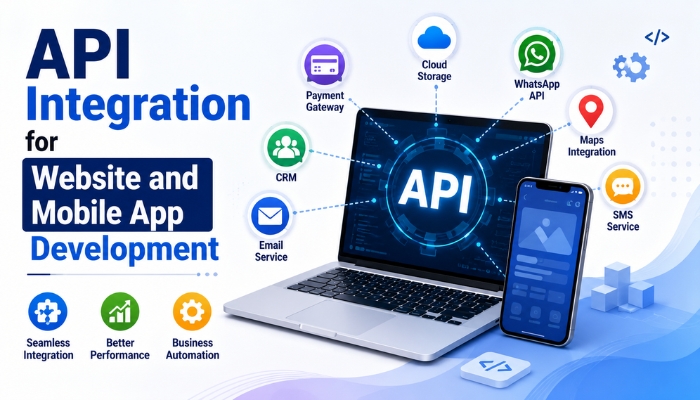
Modern businesses rely on websites and mobile applications to communicate with customers, manage operations, process transactions, and deliver digital services. However, a standalone application often cannot meet every business requirement. Organizations usually use multiple platforms such as Customer Relationship Management (CRM) software, payment gateways, accounting systems, cloud storage, marketing tools, and communication platforms. To make these systems work together seamlessly, businesses need API Integration for Website and Mobile App Development.
API integration enables websites and mobile applications to exchange data with third-party services securely and efficiently. Instead of manually transferring information between different software systems, APIs automate communication, helping businesses save time, reduce errors, and improve productivity.
Whether you are developing an eCommerce website, healthcare portal, educational platform, travel booking system, real estate application, or enterprise business software, custom API integration services help create a connected digital ecosystem that enhances user experience and supports business growth.
What Is API Integration?
An Application Programming Interface (API) is a set of protocols and rules that allows different software applications to communicate with one another. APIs act as a bridge between systems, enabling secure data exchange without exposing the internal code of each application.
For example, when a customer logs into a website using Google, completes an online payment, tracks a delivery, or receives an SMS notification, APIs are responsible for connecting these services with the website or mobile application.
API integration eliminates the need to build every feature from scratch. Developers can connect trusted third-party services to provide advanced functionality while reducing development time and improving application performance.
Today, almost every modern website and mobile app depends on APIs for providing secure, reliable, and scalable digital services.
Why API Integration Is Important for Businesses
Businesses often use separate software for sales, marketing, finance, inventory, customer support, and communication. Without integration, employees must manually update information across different platforms, increasing workload and the possibility of errors.
Professional API integration services connect these systems, ensuring that information flows automatically between applications. This improves operational efficiency while helping businesses provide faster and more accurate services to customers.
For example, when a customer places an order on an eCommerce website, API integration can automatically process the payment, update inventory, generate an invoice, notify the customer, and record the transaction in the CRM system without manual intervention.
Major Benefits of API Integration
- Automates repetitive business processes.
- Reduces manual data entry.
- Improves communication between software platforms.
- Provides real-time data synchronization.
- Enhances customer experience.
- Increases business productivity.
- Supports future business expansion.
- Improves reporting and analytics.
- Reduces operational errors.
- Creates a centralized business workflow.
How API Integration Works
Whenever a user performs an action on a website or mobile application, the application sends a request to an external API. The API processes the request and returns the required information or completes the requested task.
For example, if a customer makes an online payment, the payment gateway API securely verifies the transaction and sends the payment status back to the website. Similarly, a WhatsApp API can notify the sales team when a new enquiry is received, while a CRM API can automatically store the customer's information.
This seamless communication allows businesses to provide faster services while reducing manual work.
Popular API Integrations for Websites and Mobile Apps
1. Payment Gateway API Integration
Payment Gateway API Integration enables businesses to accept secure online payments directly through their website or mobile application. Instead of redirecting customers to multiple platforms, payments can be processed efficiently using trusted payment providers.
Businesses across eCommerce, education, healthcare, travel, and subscription services rely on payment APIs to simplify transactions and improve customer convenience.
Common Features
- Online payment processing
- UPI payments
- Credit & Debit card payments
- Net Banking
- Digital Wallets
- International payments
- Payment verification
- Refund processing
| Feature | Business Benefit |
|---|---|
| Secure Transactions | Protects customer payment information |
| Instant Payment Confirmation | Improves customer experience |
| Automated Payment Records | Reduces manual accounting work |
| Multiple Payment Options | Provides greater convenience for customers |
2. WhatsApp Business API Integration
WhatsApp Business API Integration allows businesses to communicate with customers directly through WhatsApp. It helps organizations automate notifications, manage enquiries, provide customer support, and improve lead management.
When integrated with CRM or lead management software, businesses can instantly receive customer enquiries and assign them to the appropriate sales representative.
Businesses use WhatsApp API for:
- Lead notifications
- Appointment reminders
- Order status updates
- Customer support
- Service notifications
- Business communication
- Marketing campaigns (where applicable)
Integrating WhatsApp with websites and mobile apps improves communication while helping businesses respond to customer enquiries more efficiently.
3. CRM API Integration
CRM API Integration connects customer relationship management software with websites, mobile applications, and other business systems.
Instead of manually entering customer information, the CRM automatically captures leads, stores customer details, tracks sales activities, and organizes follow-up processes.
This helps businesses maintain accurate customer records while improving sales efficiency.
CRM Integration Features
- Automatic lead capture
- Lead assignment
- Sales pipeline management
- Customer history
- Follow-up reminders
- Reporting
- Customer segmentation
- Marketing integration
4. Email API Integration
Email remains one of the most effective business communication channels. Email API Integration allows websites and mobile applications to automatically send transactional and business emails without manual effort.
Whether confirming registrations, sending invoices, resetting passwords, or delivering newsletters, email APIs help businesses communicate consistently with customers.
Common Email API Uses
- User registration emails
- Password recovery
- Invoice delivery
- Welcome emails
- Newsletter distribution
- Order confirmations
- Account notifications
5. SMS API Integration
SMS API Integration allows businesses to send instant text messages directly from their software systems. SMS notifications are commonly used because they reach customers quickly and work across almost all mobile devices.
Businesses use SMS APIs for security, customer communication, appointment reminders, and transactional notifications.
Popular SMS API Applications
- OTP verification
- Appointment reminders
- Delivery updates
- Booking confirmations
- Payment notifications
- Customer alerts
- Service reminders
| API Type | Main Purpose | Industries |
|---|---|---|
| Payment API | Online Payments | Ecommerce, Healthcare, Education |
| CRM API | Customer Management | All Businesses |
| WhatsApp API | Business Communication | Sales, Support, Marketing |
| Email API | Email Automation | Every Industry |
| SMS API | Instant Notifications | Banking, Ecommerce, Healthcare |
6. Google Maps API Integration
Google Maps API Integration is widely used in businesses that depend on location-based services. It enables websites and mobile applications to display maps, locate businesses, calculate routes, and provide navigation support.
Industries such as logistics, food delivery, travel, healthcare, and real estate use Google Maps APIs to improve customer convenience and operational efficiency.
Features of Google Maps API
- Interactive maps
- Business locations
- Route planning
- Location search
- Nearby services
- Distance calculation
- Live location support
7. Social Media API Integration
Social Media API Integration enables websites and mobile applications to connect with popular social networking platforms such as Google, Facebook, LinkedIn, and X (formerly Twitter). These integrations simplify user authentication, improve engagement, and allow businesses to increase their online visibility.
Instead of creating a new account manually, users can quickly sign in using their existing social media profiles. This reduces registration time and enhances the overall user experience.
Benefits of Social Media API Integration
- Google Login
- Facebook Login
- LinkedIn Login
- Social Sharing
- Profile Synchronization
- User Authentication
- Improved User Experience
8. Cloud Storage API Integration
Cloud Storage API Integration allows businesses to securely store, manage, and retrieve files from cloud platforms. Instead of maintaining large local servers, organizations can use cloud services to improve scalability and data security.
Cloud APIs are commonly used for document management systems, mobile applications, educational platforms, healthcare portals, and enterprise software.
Common Features
- File Upload
- Image Storage
- Document Management
- Automatic Backup
- Cloud Synchronization
- Secure File Access
- Large File Storage
9. Analytics API Integration
Analytics API Integration helps businesses collect valuable information about website visitors, mobile app users, customer behavior, and marketing performance. These insights help companies make informed business decisions.
Analytics APIs allow organizations to monitor user activity in real time, identify successful marketing campaigns, and improve customer engagement.
Analytics Can Measure
- Website Visitors
- Mobile App Usage
- User Engagement
- Traffic Sources
- Conversion Rate
- Bounce Rate
- Campaign Performance
- Customer Behavior
10. ERP API Integration
ERP API Integration connects enterprise resource planning software with websites, mobile applications, CRM systems, accounting software, inventory systems, and business management platforms.
This integration enables organizations to synchronize important business information across departments, reducing duplicate work and improving operational efficiency.
ERP Integration Features
- Inventory Management
- Sales Management
- Purchase Orders
- Finance Integration
- Customer Information
- Supplier Management
- Business Reporting
Benefits of API Integration for Website and Mobile App Development
Implementing API Integration for Website and Mobile App Development offers significant advantages for businesses of every size. Whether you operate a startup or a large enterprise, integrating business applications improves efficiency while delivering a better customer experience.
- Improves customer experience with advanced features.
- Reduces manual work and repetitive tasks.
- Automates business workflows.
- Provides real-time data synchronization.
- Improves business productivity.
- Enhances software scalability.
- Supports business growth.
- Improves reporting accuracy.
- Connects multiple software systems.
- Provides secure communication between applications.
Industries That Use API Integration
Almost every industry depends on APIs to improve digital services and automate operations.
| Industry | Popular API Integrations |
|---|---|
| Healthcare | Appointment Booking, Patient Records, Payment Gateway |
| Education | Student Management, Payment API, Notifications |
| Real Estate | CRM, Google Maps, WhatsApp API |
| Ecommerce | Payment Gateway, Shipping API, Inventory API |
| Finance | Banking API, Verification API, Payment API |
| Travel | Booking API, Maps API, Payment Integration |
API Integration Development Process
Developing a secure and scalable API integration follows a structured process that ensures reliability and performance.
- Business Requirement Analysis
- Select the Appropriate API
- Authentication Configuration
- Database Planning
- API Development
- Testing & Validation
- Security Implementation
- Deployment
- Performance Monitoring
- Maintenance & Updates
Following these steps ensures that API integrations remain secure, scalable, and compatible with future business requirements.
API Security Best Practices
Security is one of the most important aspects of API integration services. Businesses should always follow industry-standard security practices to protect customer information and business data.
- HTTPS Encryption
- OAuth Authentication
- API Keys
- JWT Token Authentication
- Role-Based Access Control
- Rate Limiting
- Data Validation
- Activity Logging
- Firewall Protection
- Regular Security Audits
Challenges in API Integration
Although APIs simplify business operations, organizations may face technical challenges during implementation.
- Authentication Issues
- API Version Compatibility
- Performance Optimization
- Large Data Synchronization
- Error Handling
- Third-Party Dependency
- Security Risks
- Documentation Limitations
Working with an experienced API Integration Company helps businesses overcome these challenges efficiently.
API Integration vs Manual Data Management
| Feature | Manual Process | API Integration |
|---|---|---|
| Data Entry | Manual | Automated |
| Accuracy | Moderate | High |
| Speed | Slow | Fast |
| Business Workflow | Separate Systems | Connected Systems |
| Reporting | Manual | Real-Time |
| Scalability | Limited | Excellent |
| Customer Experience | Average | Improved |
Why Choose Professional API Integration Services?
A professional API Integration Company understands how to securely connect different business applications while maintaining performance and scalability. Choosing experienced developers ensures reliable integrations that support long-term business growth.
Professional API Integration Services Include:
- Custom API Development
- Website API Integration
- Mobile App API Integration
- CRM Integration
- ERP Integration
- Payment Gateway Integration
- WhatsApp Business API Integration
- Email API Integration
- SMS API Integration
- Google Maps API Integration
- Cloud Storage Integration
- Analytics Integration
- Third-Party API Integration
- API Testing
- API Maintenance & Support
Frequently Asked Questions (FAQs)
1. What is API Integration?
API Integration allows different software applications to communicate securely and exchange data automatically.
2. Why is API Integration important?
It improves automation, reduces manual work, enhances customer experience, and connects multiple business systems.
3. Which businesses need API Integration?
Healthcare, education, finance, eCommerce, logistics, travel, manufacturing, and real estate businesses all benefit from API integration.
4. Is API Integration secure?
Yes. When implemented correctly using HTTPS, OAuth, API Keys, and secure authentication methods, API integration provides a highly secure communication channel.
5. Can APIs be integrated into existing websites?
Yes. Existing websites and mobile applications can be upgraded with new APIs without rebuilding the entire system.
Conclusion
API Integration for Website and Mobile App Development plays a vital role in creating modern, connected, and scalable digital platforms. From payment gateways and CRM software to WhatsApp Business API, Google Maps, cloud storage, ERP systems, and analytics tools, APIs help businesses automate operations, improve customer engagement, and streamline workflows.
By investing in custom API integration services, businesses can reduce manual work, improve operational efficiency, enhance user experiences, and build future-ready websites and mobile applications capable of supporting long-term business growth.