
- Complete IT Solutions for a Digital World
API Integration vs Manual Data Entry: Which Is Better?
Compare API Integration and Manual Data Entry to Discover the Best Solution for Business Automation, Accuracy, Productivity, and Long-Term Growth
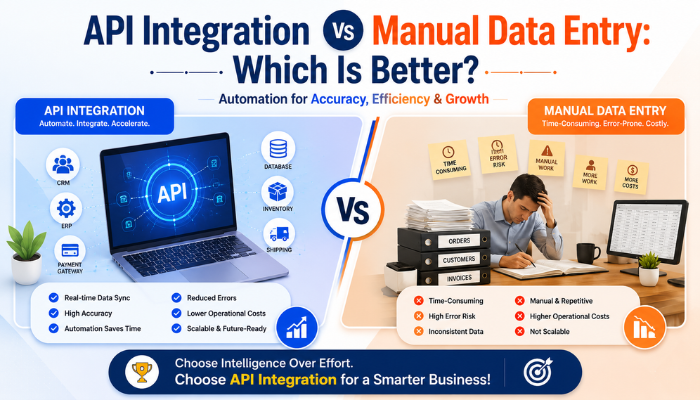
In today's digital business environment, organizations handle thousands of records every day, including customer information, invoices, inventory updates, payment transactions, employee records, and sales data. Managing this information efficiently is essential for maintaining productivity and delivering excellent customer service. Businesses that rely on outdated processes often struggle with delays, data inconsistencies, and unnecessary operational costs.
For many years, companies depended on Manual Data Entry, where employees entered information into spreadsheets, databases, accounting software, or business management systems by hand. Although this process is simple to understand, it is time-consuming, repetitive, and highly vulnerable to human error.
Today, modern businesses are adopting API Integration Services to automate communication between different software applications. Instead of entering the same information repeatedly, APIs automatically exchange data between systems such as CRM Software, ERP Software, Accounting Software, Payment Gateways, E-Commerce Platforms, and Inventory Management Systems.
Whether you own an online store, healthcare organization, educational institute, logistics company, or service-based business, choosing between API Integration and Manual Data Entry can directly influence your productivity, operational efficiency, and business growth.
This comprehensive comparison explains both approaches, highlights their advantages and disadvantages, and helps you determine which solution best fits your business requirements.
What is API Integration?
API Integration (Application Programming Interface Integration) is the process of connecting two or more software applications so they can exchange information automatically without requiring manual intervention. APIs allow different systems to communicate securely and instantly, ensuring that data remains synchronized across all connected platforms.
Instead of manually copying information between software applications, API Integration transfers data automatically whenever an event occurs. This reduces repetitive work, improves accuracy, and enables businesses to automate complex workflows.
Examples of API Integration
- Customer orders automatically sync from an e-commerce website to CRM software.
- Online payments instantly update accounting software.
- Inventory levels automatically decrease after every sale.
- Shipping requests are sent directly to courier partners.
- Customer information is synchronized across multiple business applications.
- Lead data from website forms automatically enters CRM systems.
Popular API Integration Services
- Payment Gateway API Integration
- WhatsApp Business API Integration
- SMS API Integration
- CRM API Integration
- ERP API Integration
- Accounting Software API
- Inventory Management API
- Email API Integration
- Shipping API Integration
- Social Media API Integration
What is Manual Data Entry?
Manual Data Entry is the traditional process of entering business information manually into spreadsheets, software applications, databases, or paper records. Employees type customer information, invoices, payment records, inventory updates, and financial data individually into each business system.
Although manual data entry requires little technical setup, it becomes increasingly inefficient as businesses grow. Employees often spend several hours performing repetitive tasks that could otherwise be automated.
Common Examples of Manual Data Entry
- Entering customer information into CRM software.
- Updating inventory after every sale.
- Recording invoices manually.
- Updating payment status.
- Maintaining Excel spreadsheets.
- Copying data between multiple software applications.
- Preparing financial reports manually.
Why Businesses Are Moving Toward API Integration
Digital transformation has changed customer expectations. Businesses now require instant information sharing, real-time reporting, automated workflows, and faster customer service. Manual processes often create delays that negatively impact both employees and customers.
Professional API Integration Services automate repetitive tasks while allowing different software applications to communicate automatically. This eliminates duplicate work, reduces administrative effort, and improves overall business performance.
Benefits Driving API Adoption
- Business Process Automation
- Real-Time Data Synchronization
- Reduced Human Errors
- Faster Business Operations
- Lower Operational Costs
- Improved Productivity
- Better Customer Experience
- Cloud Connectivity
- Scalable Business Infrastructure
- Digital Transformation
API Integration vs Manual Data Entry
| Feature | API Integration | Manual Data Entry |
|---|---|---|
| Data Transfer | Automatic | Manual |
| Processing Speed | Instant | Slow |
| Accuracy | Very High | Depends on User |
| Human Errors | Very Low | High |
| Automation | Complete | Not Available |
| Scalability | Excellent | Limited |
| Operational Cost | Lower Long-Term | Higher |
| Business Productivity | High | Moderate |
| Real-Time Updates | Yes | No |
1. Faster Business Operations
One of the biggest advantages of API Integration is speed. Whenever a customer places an order, submits a form, completes a payment, or updates information, APIs instantly transfer that data across connected systems without requiring manual input.
For example, an online order can automatically generate an invoice, update inventory, notify the warehouse, process payment, and record customer details in the CRM within seconds. Manual data entry requires employees to complete each of these tasks separately, resulting in slower workflows and delayed customer service.
Benefits of Automated Workflows
- Instant Data Transfer
- Automated Order Processing
- Faster Invoice Generation
- Quick Payment Updates
- Improved Business Efficiency
- Reduced Processing Time
2. Improved Data Accuracy
Human errors are one of the biggest drawbacks of manual data entry. Typing mistakes, duplicate records, missing information, incorrect calculations, and outdated customer details can negatively affect business operations.
With API Integration, information is transferred directly between connected systems without requiring employees to repeatedly enter the same data. This dramatically improves accuracy while reducing costly business errors.
Advantages of Accurate Data Synchronization
- Fewer Typing Errors
- Accurate Customer Records
- Reliable Financial Data
- Reduced Duplicate Entries
- Better Decision Making
- Improved Customer Satisfaction
3. Increased Employee Productivity
Employees are valuable assets, and their time should be spent on strategic tasks rather than repetitive administrative work. When businesses rely on Manual Data Entry, employees often spend hours entering customer details, processing invoices, updating inventory records, and transferring information between different software applications.
With API Integration Services, these repetitive processes are automated, allowing employees to focus on customer support, sales, marketing, and business development. This not only improves productivity but also increases employee satisfaction by reducing repetitive workloads.
Benefits of Improved Productivity
- Reduced Administrative Work
- Faster Task Completion
- Higher Employee Efficiency
- Better Team Collaboration
- Improved Customer Service
- More Time for Business Growth
4. Lower Operational Costs
Although implementing API Integration requires an initial investment, it significantly reduces long-term business expenses. Manual data entry often requires additional staff, increased administrative effort, and frequent corrections due to human errors.
Automated workflows eliminate repetitive work, reduce labor costs, minimize billing mistakes, and improve resource utilization. Over time, these savings provide an excellent return on investment for businesses of all sizes.
Cost Saving Benefits
- Lower Labor Costs
- Reduced Administrative Expenses
- Fewer Data Entry Errors
- Lower Maintenance Costs
- Improved Business Profitability
- Higher Return on Investment (ROI)
5. Real-Time Data Synchronization
One of the greatest advantages of API Integration is real-time synchronization. Whenever information changes in one system, every connected application updates automatically within seconds.
For example, when a customer places an order on your website, inventory is updated automatically, payment information is recorded, invoices are generated, shipping partners receive order details, and CRM software stores customer information—all without any manual intervention.
Benefits of Real-Time Updates
- Live Inventory Updates
- Instant Payment Confirmation
- Automatic Invoice Generation
- Real-Time Customer Records
- Accurate Financial Reports
- Faster Decision Making
6. Better Customer Experience
Customers expect quick responses, accurate information, and seamless service. Businesses using API Integration Services can automatically send order confirmations, payment receipts, shipping updates, and customer notifications without delays.
Automated communication improves customer trust, reduces response times, and creates a better overall customer experience compared to businesses relying solely on manual processes.
7. Enhanced Data Security
Professional API Integration Services include advanced security measures to protect sensitive business and customer data. Secure APIs use encrypted communication, authentication mechanisms, and controlled access to ensure that information remains protected.
Security Features
- Data Encryption
- Secure Authentication
- Access Control
- API Tokens
- Secure Cloud Communication
- Regular Security Updates
Industries That Benefit from API Integration
| Industry | Common API Integrations | Business Benefits |
|---|---|---|
| E-Commerce | Payment Gateway, Shipping API | Automated Orders & Payments |
| Healthcare | Patient Management API | Digital Patient Records |
| Education | Student Information API | Automated Student Management |
| Finance | Banking API | Real-Time Transactions |
| Retail | Inventory API | Stock Management |
| Hospitality | Booking API | Reservation Automation |
| Manufacturing | ERP API | Production Management |
| Logistics | Courier API | Shipment Tracking |
| Real Estate | CRM API | Lead Management |
When Manual Data Entry May Still Be Useful
Although API Integration is the preferred choice for growing businesses, manual data entry can still be useful in certain situations. Small businesses with very limited daily transactions, one-time data migration projects, temporary record updates, or organizations using only a single software application may not require immediate automation.
However, as business operations expand and multiple software systems are introduced, manual processes become increasingly difficult to manage. At that stage, API Integration becomes essential for maintaining efficiency and supporting business growth.
How to Choose the Right Solution
Choose API Integration If Your Business:
- Uses Multiple Software Applications
- Processes Large Volumes of Data
- Requires Workflow Automation
- Needs Real-Time Reporting
- Accepts Online Payments
- Operates an E-Commerce Website
- Wants to Reduce Operational Costs
- Plans to Scale in the Future
Manual Data Entry May Be Suitable If:
- Your Business Is Very Small
- You Handle Few Daily Transactions
- You Use Only One Software Application
- Your Automation Requirements Are Minimal
API Integration vs Manual Data Entry: Final Comparison
| Criteria | API Integration | Manual Data Entry |
|---|---|---|
| Speed | ★★★★★ | ★★☆☆☆ |
| Accuracy | ★★★★★ | ★★☆☆☆ |
| Automation | ★★★★★ | ★☆☆☆☆ |
| Scalability | ★★★★★ | ★★☆☆☆ |
| Security | ★★★★★ | ★★★☆☆ |
| Overall Business Efficiency | ★★★★★ | ★★☆☆☆ |
Conclusion
Both API Integration and Manual Data Entry have their place in business operations, but for organizations focused on efficiency, automation, and long-term growth, API Integration Services provide a far superior solution. By connecting multiple software applications, APIs eliminate repetitive tasks, reduce errors, improve data accuracy, and enable real-time information sharing across your organization.
While manual data entry may still work for businesses with very limited transactions, it becomes increasingly inefficient as operations grow. Investing in professional API Integration Services helps businesses streamline workflows, improve customer experiences, reduce operational costs, and build a scalable digital infrastructure for future success.
Whether you need Payment Gateway API Integration, CRM Integration, ERP Integration, WhatsApp Business API, Shipping API, or other third-party integrations, adopting API technology is a strategic step toward improving productivity and accelerating digital transformation.