
- Complete IT Solutions for a Digital World
Connecting Websites, Software and Mobile Apps Through APIs
How API integrations connect websites, business software, and mobile apps to create seamless data exchange and connected digital workflows.
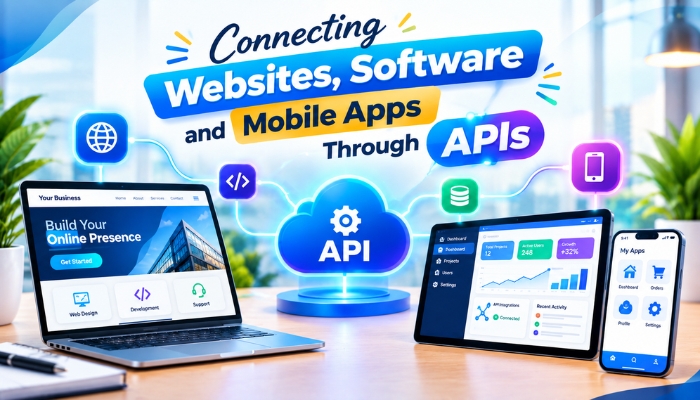
Modern businesses often use multiple digital systems to manage their daily operations. A website may handle customer inquiries, business software may manage internal processes, and a mobile app may provide services directly to users. When these systems work separately, businesses may face duplicated data, manual updates, and disconnected workflows.
API integration provides a way to connect these different platforms and allow them to exchange information. By connecting websites, software, and mobile applications through APIs, businesses can create a more coordinated digital environment where information can move between systems efficiently.
What Is an API Integration?
An API, or Application Programming Interface, allows different software systems to communicate with each other. Instead of creating separate systems that operate independently, APIs provide a structured way for one application to request or send information to another application.
For example, when a customer submits an inquiry through a website, an API can transfer that information to business software or a CRM system. The same information can then be accessed through an authorized mobile application or another connected platform.
Connecting a Website With Business Software
A website is often the first point of interaction between a business and its customers. Connecting the website with internal software can help information collected online reach the appropriate business system without requiring employees to enter the same data manually.
Common examples include connecting:
- Website inquiry forms with CRM systems
- Online orders with inventory software
- Customer registrations with business databases
- Appointment forms with scheduling systems
- Payment systems with accounting software
These integrations can help create a smoother flow of information between the customer-facing website and internal business processes.
Connecting Mobile Apps With Existing Software
Mobile applications often need access to information stored in business software or databases. APIs can act as the communication layer between the mobile app and the backend system.
For example, a mobile application can use APIs to retrieve customer information, display order status, update account details, submit requests, or send new information back to the central software system.
This approach allows the mobile application and business software to work with connected data while maintaining separate interfaces for different users.
Creating a Connected Digital Ecosystem
Businesses may use several platforms for different functions, but these systems do not always need to operate independently. API integration can connect multiple applications and create a coordinated digital ecosystem.
A typical setup may include a website connected to a CRM, payment gateway, inventory system, mobile application, and reporting platform. Each system can perform its specific function while APIs help transfer relevant information between them.
Benefits of Connecting Digital Platforms Through APIs
Reduced Manual Data Entry
When information can automatically move from one system to another, employees may spend less time entering the same information repeatedly. This can make routine workflows more efficient.
Better Data Consistency
Connected systems can share information from centralized or synchronized data sources. This can help reduce situations where different platforms contain outdated or inconsistent information.
Faster Information Exchange
APIs can allow systems to exchange information whenever a defined action or request occurs. This can be useful for businesses that depend on timely updates between different platforms.
Improved Customer Experience
When websites, mobile apps, and backend software are properly connected, customers can receive more consistent information across different touchpoints. For example, an order placed through a website may also become available through a mobile application.
Flexible Business Workflows
API-based architecture can make it easier to connect additional services as business requirements change. New tools can be integrated without necessarily replacing the entire existing system.
Common API Integration Use Cases
API integrations can support a wide range of business processes. Some common examples include:
| Business Requirement | Possible API Connection |
|---|---|
| Lead Management | Website forms with CRM or lead management software |
| Online Payments | Website or app with payment gateway |
| Order Management | E-commerce website with inventory software |
| Customer Accounts | Mobile app with customer database |
| Notifications | Business software with SMS, email, or messaging services |
| Reporting | Business applications with analytics or reporting platforms |
Planning API Integrations for Business Systems
Successful API integration requires more than simply connecting two applications. Businesses should first identify which systems need to communicate, what information needs to be exchanged, and when that information should be transferred.
It is also important to consider authentication, data formats, permissions, error handling, API limits, and system scalability. A well-planned integration can make future changes easier while reducing unnecessary technical complexity.
Security Considerations for API Connections
APIs often provide access to business and customer information, making security an important part of the integration process. Authentication and authorization mechanisms should be implemented to control which applications and users can access specific resources.
Businesses should also consider secure data transmission, access permissions, monitoring, validation, and appropriate error handling when designing API-based connections.
Building a Scalable API-Based Architecture
As a business grows, the number of applications and integrations may increase. Designing APIs with scalability in mind can help businesses accommodate additional users, platforms, and services.
A scalable architecture should consider expected traffic, database performance, API versioning, system dependencies, monitoring, and future integration requirements. This can help prevent existing integrations from becoming a limitation as the business expands.
Conclusion
Connecting websites, software, and mobile apps through APIs can help businesses create coordinated digital workflows. Instead of keeping each platform isolated, API integrations allow relevant information to move between systems and support connected business processes.
From CRM and payment integrations to mobile applications, e-commerce systems, and internal business software, APIs can provide the communication layer required to connect different technologies. With proper planning, security, and scalability considerations, businesses can build digital systems that work together more efficiently and adapt to changing requirements.