
- Complete IT Solutions for a Digital World
eBilling vs Traditional Billing: Which Is Better for Your Business
Compare eBilling and Traditional Billing to Find the Best Billing Solution for Faster Invoicing, Better Accuracy, Lower Costs, and Business Growth
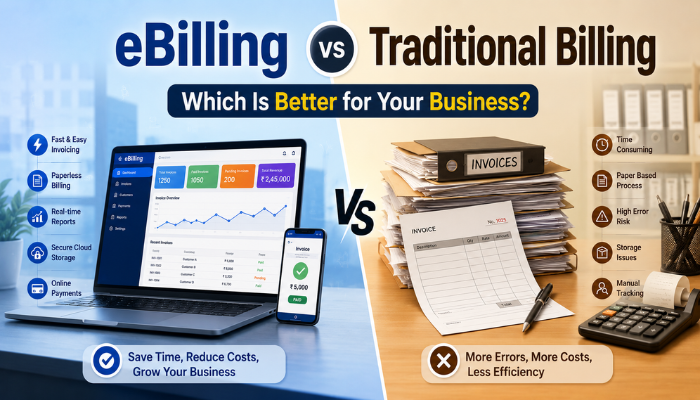
In today's rapidly evolving digital economy, businesses are continuously searching for smarter and more efficient ways to manage their financial operations. One of the most important areas of every organization is its billing process. Whether you operate a retail store, hospital, restaurant, educational institute, manufacturing company, wholesale business, or service organization, selecting the right Billing Software plays a major role in improving operational efficiency and customer satisfaction.
For decades, Traditional Billing has been the preferred method of generating invoices and maintaining financial records. Businesses relied on handwritten bills, printed invoices, spreadsheets, and manual calculations to manage customer payments. Although this method is familiar, it often consumes valuable time and increases the possibility of human errors.
Today, businesses are rapidly adopting eBilling Software, also known as Electronic Billing Software, to automate invoice generation, payment collection, tax calculations, customer management, and financial reporting. Modern Cloud-Based Billing Software enables organizations to create invoices within seconds while securely storing all billing information online.
The question many business owners ask is whether they should continue using traditional billing methods or switch to a modern Online Billing System. In this guide, we compare both solutions in detail to help you determine which billing method best supports your business goals.
What is eBilling?
eBilling (Electronic Billing) is a digital invoicing system that allows businesses to create, manage, send, and store invoices electronically. Instead of printing paper invoices, organizations use Billing Management Software or Cloud Billing Software to generate professional invoices instantly.
An Electronic Billing System simplifies business operations by automating invoice creation, calculating taxes, tracking payments, generating reports, and maintaining customer records. Because all information is stored digitally, businesses can access billing data anytime using a computer, laptop, tablet, or smartphone.
Key Features of eBilling Software
- Automated Invoice Generation
- GST Billing Software
- Cloud-Based Billing System
- Online Payment Integration
- Inventory Management
- Customer Database Management
- Expense Tracking
- Sales Reports & Analytics
- Multi-User Access
- Automatic Tax Calculation
- Payment Reminder Notifications
- Secure Cloud Storage
What is Traditional Billing?
Traditional Billing is the conventional method of generating invoices manually using paper bills, printed receipts, spreadsheets, or desktop accounting software. Businesses calculate taxes manually, record payments by hand, and store physical copies of invoices for future reference.
Although traditional billing remains common among small businesses, it often requires significant administrative effort. As transaction volumes increase, managing paper records becomes increasingly difficult and time-consuming.
Common Traditional Billing Methods
- Handwritten Bills
- Printed Paper Invoices
- Manual GST Calculation
- Excel Billing Sheets
- Physical Record Maintenance
- Manual Payment Tracking
- Paper Receipt Storage
- File-Based Documentation
Why Businesses Are Switching to eBilling Software
Digital transformation has changed customer expectations. Today's consumers expect businesses to provide fast invoices, secure online payment options, digital receipts, and real-time transaction updates. Traditional billing methods often fail to meet these expectations due to slower processing times and manual operations.
Businesses using Electronic Billing Software benefit from faster workflows, reduced paperwork, improved financial accuracy, and better customer experiences. Cloud technology also enables managers to monitor billing activities from anywhere, making remote business management easier than ever before.
Major Reasons Businesses Prefer eBilling
- Paperless Billing Process
- Faster Invoice Creation
- Automatic GST Calculation
- Reduced Human Errors
- Online Payment Collection
- Real-Time Financial Reports
- Improved Customer Experience
- Lower Operational Costs
- Cloud Accessibility
- Better Business Productivity
eBilling vs Traditional Billing Comparison
| Feature | eBilling | Traditional Billing |
|---|---|---|
| Invoice Generation | Automatic | Manual |
| Processing Speed | Fast | Slow |
| Paper Usage | Paperless | High Paper Consumption |
| Data Storage | Cloud Storage | Physical Files |
| Error Rate | Very Low | Higher |
| Accessibility | Anywhere | Office Only |
| Payment Integration | Supported | Limited |
| Tax Calculation | Automatic | Manual |
| Financial Reports | Real-Time | Manual Reports |
| Business Efficiency | High | Moderate |
1. Faster Invoice Generation
One of the biggest advantages of eBilling Software is the ability to generate professional invoices within seconds. Businesses no longer need to calculate totals manually or prepare invoices from scratch. Modern Invoice Management Software automatically fills customer information, product details, taxes, discounts, and payment terms.
Faster billing improves customer satisfaction while allowing businesses to serve more customers in less time. It also minimizes billing delays and enhances operational efficiency.
Benefits of Automated Invoice Generation
- Quick Invoice Creation
- Automatic GST Calculation
- Professional Invoice Templates
- Reduced Manual Work
- Improved Billing Accuracy
- Instant Invoice Sharing
2. Improved Billing Accuracy
Manual billing often results in calculation mistakes, duplicate invoices, incorrect tax entries, and payment tracking errors. These mistakes can negatively affect customer trust and business profitability. eBilling Software automatically performs calculations, ensuring every invoice is accurate and compliant with tax regulations.
By eliminating manual calculations, businesses can reduce billing disputes, improve customer confidence, and save valuable administrative time.
Advantages of Accurate Digital Billing
- Automatic Tax Calculation
- Error-Free Invoices
- Accurate Payment Records
- Reduced Billing Disputes
- Improved Financial Management
- Better Customer Satisfaction
3. Lower Operational Costs
Traditional billing requires paper, printers, ink, storage cabinets, courier services, and additional administrative staff. Over time, these expenses significantly increase operational costs.
Cloud-Based Billing Software eliminates most of these expenses by digitizing the entire billing process. Businesses can generate, send, and store invoices electronically without investing in physical paperwork.
Cost Savings with eBilling
- Reduced Printing Costs
- Paperless Documentation
- Lower Storage Expenses
- Reduced Administrative Work
- Faster Invoice Processing
- Higher Business Profitability
4. Better Customer Experience
Customers appreciate businesses that provide quick and convenient billing services. Electronic Billing Software enables businesses to instantly send invoices through email, SMS, or WhatsApp while offering multiple online payment options.
Faster billing and digital payment methods improve customer convenience, resulting in higher satisfaction and increased customer loyalty.
5. Real-Time Reports and Business Analytics
One of the biggest strengths of modern Billing Management Software is its ability to generate live reports. Business owners can monitor sales, revenue, outstanding payments, taxes, and customer transactions through interactive dashboards.
Reports Available in eBilling Software
- Daily Sales Reports
- Monthly Revenue Reports
- GST Reports
- Outstanding Payment Reports
- Customer Transaction History
- Inventory Reports
- Profit & Loss Summary
6. Secure Data Storage
Unlike traditional paper records that can be damaged or misplaced, Cloud Billing Software securely stores invoices and financial data on protected cloud servers. Businesses can retrieve records instantly whenever required.
Security Features
- Cloud Backup
- Data Encryption
- User Authentication
- Role-Based Access
- Automatic Backup
- Disaster Recovery
Advantages of Traditional Billing
Although businesses are rapidly adopting digital billing systems, traditional billing still has some advantages for businesses with limited transactions or minimal technology requirements.
- No Internet Connection Required
- Simple Billing Process
- Suitable for Small Shops
- Low Initial Investment
- Easy for Businesses with Limited Transactions
Challenges of Traditional Billing
- Manual Invoice Preparation
- Time-Consuming Process
- Higher Risk of Human Errors
- Paper Record Management
- Difficult Data Retrieval
- Limited Business Reports
- No Remote Access
- Higher Administrative Costs
- Poor Scalability
Industries That Benefit from eBilling Software
| Industry | Benefits of eBilling |
|---|---|
| Retail Stores | Fast Billing & Inventory Management |
| Healthcare | Patient Billing & Digital Records |
| Educational Institutions | Online Fee Collection |
| Restaurants | Quick POS Billing |
| Hotels | Guest Billing Automation |
| Manufacturing | Invoice Automation |
| Wholesale Businesses | Bulk Invoice Generation |
| E-Commerce | Order Billing & Payment Tracking |
| Service Providers | Customer Invoice Management |
How to Choose the Right Billing Solution
Factors to Consider
- Business Size
- Daily Transaction Volume
- GST Compliance
- Cloud Accessibility
- Data Security
- Inventory Management
- Online Payment Integration
- Reporting Features
- Customer Management
- Scalability
- Technical Support
- Budget
eBilling vs Traditional Billing: Final Comparison
| Criteria | eBilling | Traditional Billing |
|---|---|---|
| Speed | ★★★★★ | ★★☆☆☆ |
| Accuracy | ★★★★★ | ★★★☆☆ |
| Security | ★★★★★ | ★★☆☆☆ |
| Accessibility | ★★★★★ | ★★☆☆☆ |
| Cost Efficiency | ★★★★★ | ★★★☆☆ |
| Business Growth Support | ★★★★★ | ★★☆☆☆ |
Conclusion
Both eBilling and Traditional Billing have their own advantages, but for businesses aiming to improve efficiency, reduce costs, and embrace digital transformation, eBilling Software is the clear winner. It offers faster invoice generation, improved accuracy, secure cloud storage, real-time reporting, automated tax calculations, and seamless online payment integration.
While traditional billing may still be suitable for very small businesses with limited daily transactions, growing organizations can significantly benefit from adopting a Cloud-Based Billing System. By implementing modern Billing Management Software, businesses can streamline operations, improve customer satisfaction, maintain accurate financial records, and prepare for long-term growth.
Investing in the right Electronic Billing Software today helps businesses stay competitive, reduce manual work, improve productivity, and build a more efficient financial management system for the future.