
- Complete IT Solutions for a Digital World
How the Right Software Solution Can Transform Business Workflows
Discover how the right software solution can streamline business workflows, automate repetitive tasks, improve team collaboration, organize data, and suppo
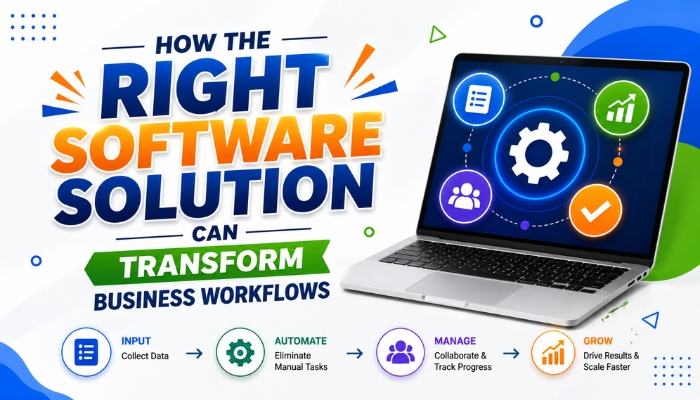
Modern businesses handle many daily activities, including customer management, employee coordination, data handling, reporting, billing, inventory, and communication. Managing these processes manually or through disconnected tools can consume valuable time and increase the chances of errors.
The right software solution can bring important business activities together and make workflows more organized. Instead of depending on multiple applications or repetitive manual tasks, businesses can use software designed around their specific requirements.
In this blog, we will explore how the right software solution can transform business workflows and help organizations manage their operations more effectively.
1. Automates Repetitive Business Tasks
Many businesses spend considerable time on repetitive activities such as data entry, report generation, notifications, follow-ups, and record updates.
Business software can automate many of these tasks and reduce the need for repetitive manual work.
It can help businesses:
- Automate routine processes
- Reduce manual data entry
- Generate reports
- Send notifications and reminders
- Update records automatically
Automation allows employees to spend more time on important business activities instead of repetitive administrative work.
2. Centralizes Business Information
Businesses often store information across spreadsheets, emails, documents, and different applications. This can make it difficult to find the right information when it is needed.
A centralized software solution can bring important business data into one system.
For example, businesses can manage:
- Customer information
- Sales records
- Employee details
- Business transactions
- Reports and documents
Having information in one place can make daily operations more organized and easier to manage.
3. Improves Team Collaboration
Effective collaboration is important for completing business tasks on time. When employees use different tools to communicate and manage tasks, information can sometimes become difficult to track.
A suitable software solution can provide a shared environment where teams can access relevant information and coordinate their activities.
This can help employees:
- Share information
- Track assigned tasks
- Update work status
- Communicate more efficiently
- Coordinate with different departments
Better collaboration can help teams work together more efficiently.
4. Makes Customer Management Easier
Customer information is an important part of many businesses. Managing leads, customer conversations, follow-ups, and sales activities manually can become difficult as the customer base grows.
A software solution with customer management features can help businesses organize these activities.
It can support:
- Lead management
- Customer records
- Follow-up tracking
- Sales pipeline management
- Customer communication
This can help businesses maintain better control over customer-related workflows.
5. Reduces Human Errors
Manual processes can sometimes lead to incorrect data entry, missed updates, duplicate records, or calculation mistakes.
Software can standardize workflows and reduce unnecessary manual intervention.
For example, predefined processes can help ensure that information is entered consistently and important steps are not missed.
Reducing errors can improve the overall quality of business operations and make processes more reliable.
6. Improves Workflow Tracking
Business owners and managers need to know the current status of important tasks and processes.
The right software can provide clear visibility into ongoing activities.
Businesses can track:
- Pending tasks
- Completed activities
- Lead status
- Sales progress
- Employee activities
- Customer follow-ups
Better tracking allows managers to identify delays and take appropriate action when required.
7. Provides Useful Business Reports
Business decisions often depend on accurate information. Collecting data manually and preparing reports can take significant time.
Business software can organize data and generate useful reports based on different requirements.
Reports may include:
- Sales performance
- Lead activity
- Customer information
- Employee performance
- Inventory status
- Business operations
These reports can help management understand business activities and make more informed decisions.
8. Supports Business Growth
As a business grows, its processes become more complex. A system that works for a small operation may not be sufficient when the number of customers, employees, transactions, and branches increases.
A scalable software solution can be developed to support changing business requirements.
It can help businesses manage:
- More customers
- Additional employees
- Multiple departments
- Growing data volumes
- Multiple business locations
Choosing a scalable solution can make it easier to manage future growth.
9. Connects Different Business Processes
Businesses often depend on multiple systems for different activities. When these systems do not communicate with each other, employees may need to enter the same information multiple times.
Software integration can help connect different business processes.
For example, a business may connect:
- Website forms
- CRM systems
- Payment systems
- Communication platforms
- Inventory systems
- Business reporting tools
Connected systems can help information move more smoothly between different parts of the business.
10. Improves Overall Productivity
When employees have easy access to the right tools and information, they can complete tasks more efficiently.
A well-designed software solution can reduce unnecessary steps, simplify workflows, and provide quick access to important information.
This can result in:
- Faster task completion
- Better organization
- Improved communication
- Reduced repetitive work
- More efficient business processes
Improved productivity can ultimately contribute to better business performance.
Custom Software for Specific Business Requirements
Every business has different processes and operational requirements. Ready-made software may provide useful features, but it may not always match the exact workflow of a particular organization.
Custom software development allows businesses to create solutions around their specific processes.
A custom solution can include features such as:
- CRM and lead management
- Employee management
- Inventory management
- Billing and invoicing
- Reporting and analytics
- Business automation
- Multi-branch management
- Third-party API integrations
This approach allows businesses to choose features that are relevant to their operations instead of using unnecessary tools.
How to Choose the Right Software Solution
Before investing in software development, businesses should understand their current processes and identify areas that need improvement.
Consider the following factors:
- Business requirements
- Required features
- Scalability
- Security
- Ease of use
- Integration requirements
- Development and maintenance costs
A clear understanding of business needs can help ensure that the final software solution provides practical value.
Conclusion
The right software solution can transform business workflows by automating repetitive tasks, organizing information, improving collaboration, simplifying customer management, and providing better visibility into daily operations.
For businesses with unique requirements, custom software development can provide a flexible solution designed around specific workflows. By selecting the right features and focusing on scalability, usability, security, and integration, businesses can create a more organized and efficient working environment.