
- Complete IT Solutions for a Digital World
Inventory Management Features for Ecommerce Websites
Discover the essential inventory management features every ecommerce website needs to track stock, automate updates, and improve order management.
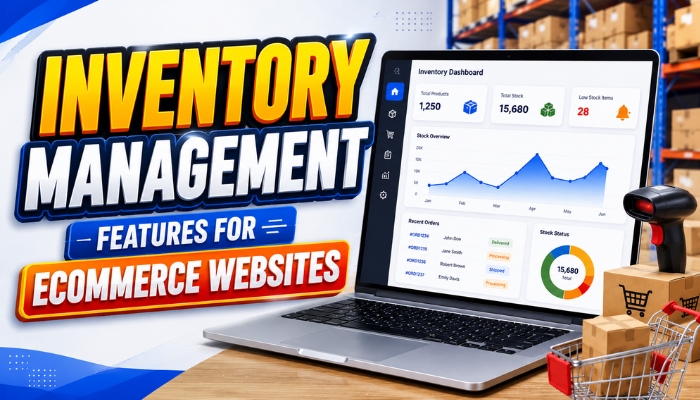
Managing inventory efficiently is one of the biggest challenges for every online business. Whether an ecommerce store sells hundreds of products or thousands of SKUs, maintaining accurate stock information is essential for delivering a smooth shopping experience. Customers expect products to be available when they place an order, and businesses need complete visibility into their inventory to avoid overselling, delayed deliveries, or stock shortages. This is why investing in a Custom Inventory Management System for Ecommerce Websites has become an important part of running a successful online business.
Modern Inventory Management Software does much more than simply record stock quantities. It helps businesses monitor inventory in real time, automate stock updates, manage suppliers, track warehouse inventory, generate reports, and synchronize products across multiple sales channels. By integrating inventory management with ecommerce websites, businesses can reduce manual work, improve order accuracy, and provide better customer service.
Whether you operate a small online store or a large ecommerce marketplace, having a reliable inventory management system ensures that your products remain organized, your operations stay efficient, and your customers receive accurate product availability information.
What Is Inventory Management?
Inventory Management is the process of tracking, organizing, controlling, and monitoring products throughout the entire business cycle. It involves maintaining accurate stock levels, recording incoming and outgoing inventory, managing warehouses, and ensuring that products are available whenever customers place an order.
In ecommerce businesses, inventory management becomes even more important because customers shop online without physically checking product availability. An effective inventory management system automatically updates stock whenever products are purchased, returned, exchanged, or restocked, ensuring that inventory information always remains accurate.
Instead of relying on manual spreadsheets, businesses can use Inventory Management Software for Ecommerce Websites to automate inventory operations and improve overall efficiency.
Why Inventory Management Is Important for Ecommerce Websites
Inventory directly impacts customer satisfaction and business profitability. If products shown on the website are actually unavailable, customers may lose trust in the business. Similarly, keeping excessive inventory increases storage costs and affects cash flow.
A professionally developed Inventory Management System helps businesses maintain the right balance between product availability and inventory investment. It enables companies to monitor stock movement, forecast demand, automate stock updates, and improve order fulfillment without unnecessary delays.
Businesses that implement inventory management software often experience better operational control, faster order processing, improved reporting, and greater customer satisfaction.
Major Benefits of Inventory Management
- Real-time inventory tracking
- Reduced stock shortages
- Prevents overselling
- Faster order fulfillment
- Better warehouse management
- Improved supplier coordination
- Automated stock updates
- Reduced manual work
- Better inventory forecasting
- Higher customer satisfaction
Key Inventory Management Features Every Ecommerce Website Should Have
1. Real-Time Inventory Tracking
Real-Time Inventory Tracking is one of the most valuable features for ecommerce businesses. Every time a customer purchases a product, cancels an order, or returns an item, the inventory should update automatically. This eliminates manual stock adjustments and ensures customers always see accurate product availability.
Real-time synchronization also helps business owners monitor inventory from multiple locations, making it easier to manage stock across warehouses and online marketplaces.
Advantages of Real-Time Inventory Tracking
- Instant stock updates
- Improved inventory accuracy
- Better order management
- Reduced inventory errors
- Enhanced customer experience
2. Multi-Warehouse Inventory Management
Many growing ecommerce businesses operate from more than one warehouse or fulfillment center. Managing inventory separately for each location becomes difficult without an integrated inventory management system.
Multi-Warehouse Inventory Management allows businesses to manage stock from different warehouses through a single dashboard. Products can be transferred between locations, warehouse stock levels can be monitored in real time, and inventory can be allocated based on customer location.
| Warehouse Feature | Business Benefit |
|---|---|
| Multiple Warehouse Support | Centralized inventory management |
| Stock Transfer | Easy movement of products |
| Warehouse Reports | Better inventory visibility |
| Location Management | Quick product identification |
| Inventory Synchronization | Real-time stock updates |
3. Automatic Stock Updates
One of the biggest advantages of using Inventory Management Software is automation. Instead of updating inventory manually after every order, the software automatically adjusts stock whenever products are sold, cancelled, returned, or restocked.
Automation reduces errors while ensuring that customers always see the latest inventory information.
- Automatic quantity updates
- Order synchronization
- Return management
- Stock adjustment history
- Reduced manual effort
4. Low Stock Alerts
Running out of stock can negatively affect sales and customer trust. A modern inventory management system continuously monitors stock levels and sends notifications whenever products reach predefined minimum quantities.
Low-stock alerts help purchasing teams reorder products before they become unavailable, reducing lost sales opportunities and improving inventory planning.
Benefits of Low Stock Alerts
- Prevents stock shortages
- Improves purchasing decisions
- Reduces emergency orders
- Supports inventory planning
- Improves customer satisfaction
5. Barcode Management
Barcode Management simplifies inventory tracking by assigning a unique barcode to every product. Warehouse staff can quickly scan products during receiving, shipping, stock verification, and transfers.
Barcode technology reduces manual entry errors while increasing inventory accuracy and operational efficiency.
- Barcode scanning
- Product identification
- Quick inventory updates
- Warehouse accuracy
- Faster order processing
6. SKU Management
Every ecommerce product should have a unique Stock Keeping Unit (SKU). SKU management helps businesses organize thousands of products efficiently while making inventory searches faster and more accurate.
Using proper SKU codes also improves reporting, warehouse management, and supplier coordination.
- Unique product identification
- Easy inventory search
- Improved reporting
- Better warehouse organization
- Simplified inventory tracking
7. Product Variants Management
Ecommerce businesses often sell products with multiple variations such as color, size, storage capacity, weight, or material. Managing each variation separately without software becomes extremely difficult.
Product Variant Management enables businesses to maintain inventory for every product variation while ensuring customers only see available options.
| Variant Type | Example |
|---|---|
| Color | Black, White, Blue |
| Size | S, M, L, XL |
| Storage | 128GB, 256GB, 512GB |
| Weight | 500g, 1kg, 5kg |
| Material | Cotton, Leather, Plastic |
8. Purchase Order Management
Purchase Order Management helps businesses manage product procurement efficiently. Instead of maintaining separate purchase records, businesses can generate purchase orders directly from the inventory management system.
The software keeps track of suppliers, ordered products, pending deliveries, received inventory, and payment history. This improves purchasing efficiency and reduces delays in stock replenishment.
- Create purchase orders
- Supplier management
- Track pending orders
- Receive inventory updates
- Purchase history management
9. Supplier Management
Supplier Management is an essential feature of an ecommerce inventory management system. Businesses often work with multiple suppliers to maintain product availability. Managing supplier information manually can become difficult as the business grows.
A modern inventory management solution stores supplier details, purchase history, payment records, delivery schedules, and product catalogs in one centralized system. This helps businesses communicate with suppliers more efficiently and maintain healthy inventory levels.
Supplier Management Features
- Supplier profile management
- Purchase history tracking
- Payment records
- Delivery schedule management
- Supplier-wise reports
- Product sourcing information
10. Order Management Integration
Order Management Integration connects your ecommerce website with the inventory management system. Whenever a customer places an order, the inventory is updated automatically, ensuring accurate stock information across all sales channels.
This integration reduces manual work while improving order accuracy and customer satisfaction. Businesses can also track order status, shipping progress, and product availability from one dashboard.
- Automatic stock deduction
- Order synchronization
- Return management
- Cancellation updates
- Shipping status tracking
Inventory Dashboard
A centralized Inventory Dashboard gives business owners complete visibility into inventory operations. Instead of checking multiple reports separately, users can monitor stock levels, warehouse inventory, sales performance, pending purchase orders, and supplier activities from one screen.
The dashboard provides real-time business insights, allowing faster decision-making and better inventory planning.
| Dashboard Information | Purpose |
|---|---|
| Available Stock | Monitor current inventory |
| Low Stock Products | Plan product replenishment |
| Out of Stock Products | Identify unavailable products |
| Recent Orders | Track customer purchases |
| Purchase Orders | Monitor incoming inventory |
| Sales Reports | Measure product performance |
Reports and Analytics
Business decisions become more effective when supported by accurate data. Inventory Reports and Analytics provide valuable insights into stock movement, purchasing trends, and product performance.
Detailed reports help businesses forecast demand, optimize inventory investment, and identify slow-moving products before they impact profitability.
Important Inventory Reports
- Inventory Valuation Report
- Stock Movement Report
- Fast Selling Products
- Slow Moving Products
- Purchase Report
- Sales Report
- Supplier Report
- Warehouse Report
Inventory Management Workflow
A well-designed Inventory Management Workflow automates product movement from procurement to delivery. Every stage is connected, ensuring accurate inventory records throughout the process.
- Product Added to Inventory
- Stock Quantity Updated
- Customer Places an Order
- Inventory Automatically Reduced
- Order Processing Begins
- Shipping Initiated
- Low Stock Alert Generated
- Purchase Order Created
- Supplier Delivers Products
- Inventory Updated Automatically
Benefits of Inventory Management Software
Using Inventory Management Software for Ecommerce Websites offers several operational and financial advantages. Businesses can automate inventory processes, improve stock accuracy, reduce costs, and deliver better customer experiences.
- Real-time inventory visibility
- Improved stock accuracy
- Reduced inventory costs
- Faster order fulfillment
- Better warehouse management
- Automated inventory updates
- Reduced manual errors
- Better purchasing decisions
- Improved customer satisfaction
- Supports business growth
Inventory Management Software vs Manual Inventory
| Feature | Manual Inventory | Inventory Software |
|---|---|---|
| Stock Updates | Manual | Automatic |
| Inventory Tracking | Limited | Real-Time |
| Reporting | Manual | Automated |
| Barcode Support | No | Yes |
| Multi-Warehouse | Difficult | Easy |
| Purchase Orders | Manual | Automated |
| Low Stock Alerts | No | Yes |
| Inventory Accuracy | Moderate | High |
Industries That Benefit from Inventory Management Software
Inventory management is useful across various industries where product availability and stock accuracy are important.
- Ecommerce Stores
- Retail Businesses
- Wholesale Distributors
- Electronics Stores
- Fashion & Apparel
- Healthcare & Pharmacy
- Manufacturing Companies
- Furniture Businesses
- Automotive Parts Suppliers
- Grocery & Supermarkets
Best Practices for Inventory Management
Following inventory management best practices helps businesses maintain accurate stock records while reducing operational costs.
- Monitor inventory in real time.
- Use barcode scanning for faster stock updates.
- Set automatic low-stock alerts.
- Perform regular inventory audits.
- Maintain accurate SKU records.
- Manage suppliers efficiently.
- Analyze inventory reports regularly.
- Forecast future product demand.
- Integrate inventory with CRM and ERP systems.
- Automate repetitive inventory tasks.
Conclusion
Inventory Management Features for Ecommerce Websites play a crucial role in helping online businesses manage products efficiently, improve order accuracy, and deliver a better shopping experience. Features such as real-time inventory tracking, multi-warehouse management, barcode scanning, supplier management, and automated stock updates simplify daily operations while reducing manual work.
By investing in a Custom Inventory Management Solution, businesses can streamline inventory processes, improve operational efficiency, reduce inventory costs, and support long-term business growth. An integrated inventory management system not only enhances productivity but also ensures that customers receive accurate product availability and timely order fulfillment.