
- Complete IT Solutions for a Digital World
Mobile App Security Features Every Business Needs
Essential mobile app security features that help businesses protect user data, secure accounts, and reduce digital risks.
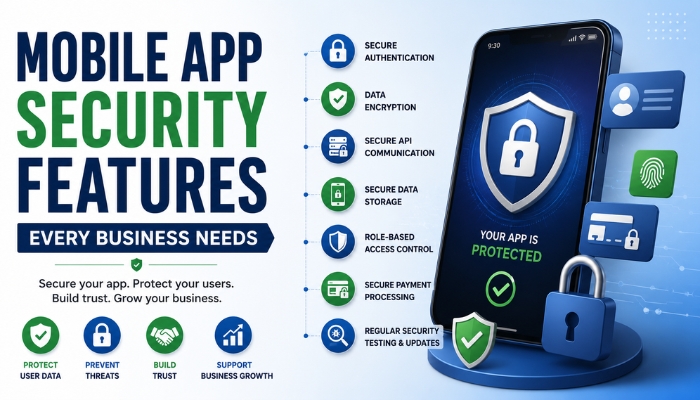
Mobile apps have become an important part of modern business operations. Companies use mobile applications to connect with customers, manage services, process transactions, share information, and improve customer engagement. As mobile apps handle valuable business and customer data, mobile app security should be a major priority during development and maintenance.
A secure mobile application helps protect sensitive information, reduce security risks, and provide users with a safer digital experience. Businesses should consider security from the planning stage instead of treating it as an afterthought.
Why Mobile App Security Is Important
Mobile applications can store or access sensitive information such as customer details, login credentials, payment information, business records, and personal data. If an app has weak security controls, attackers may attempt to exploit vulnerabilities to access accounts or data.
Strong mobile app security features can help businesses:
- Protect customer information
- Secure user accounts
- Prevent unauthorized access
- Protect sensitive business data
- Reduce the risk of data breaches
- Secure online transactions
- Build customer trust
- Support safer business operations
1. Secure User Authentication
A strong authentication system is one of the most important features of a secure mobile application. Businesses should use reliable methods to verify that users are accessing their own accounts.
Depending on the application, authentication can include:
- Strong passwords
- One-time passwords (OTP)
- Biometric authentication
- Multi-factor authentication (MFA)
- Secure account recovery
Using multiple authentication layers can provide stronger protection for applications containing sensitive information.
2. Data Encryption
Data encryption helps protect information by converting it into a format that unauthorized users cannot easily understand.
Businesses should consider encryption for both data transmitted between the mobile app and server and sensitive information stored on devices or servers.
Encryption is particularly important for:
- Customer information
- Login credentials
- Business records
- Payment-related information
- Personal data
3. Secure API Communication
Mobile applications frequently communicate with backend systems through APIs. If APIs are not properly secured, attackers may attempt to access information or perform unauthorized actions.
Secure API development should include appropriate authentication, authorization, input validation, rate limiting, and secure communication protocols.
APIs should also expose only the information and functionality that the application actually requires.
4. Secure Data Storage
Mobile applications may store certain information locally on a user's device. Sensitive information should not be stored carelessly.
Developers should evaluate what data needs to be stored locally and use appropriate platform security mechanisms for sensitive information.
For example, applications can use secure storage facilities provided by Android and iOS rather than storing sensitive credentials in plain text.
5. Role-Based Access Control
Businesses often have different types of users within their mobile applications. A customer, employee, manager, and administrator may require different permissions.
Role-based access control helps ensure that users can access only the features and information required for their role.
| User Type | Example Access |
|---|---|
| Customer | Personal profile, orders, bookings |
| Staff | Assigned customer and operational information |
| Manager | Reports and selected business functions |
| Administrator | Application and user management |
Restricting permissions can reduce the impact of compromised accounts.
6. Secure Payment Processing
If a mobile application accepts payments, security becomes even more important. Businesses should use trusted payment providers and follow applicable payment-security requirements.
A secure payment system can include:
- Encrypted communication
- Trusted payment gateways
- Secure checkout processes
- Transaction verification
- Fraud monitoring
- Appropriate access controls
Businesses should avoid unnecessarily storing sensitive payment information within the mobile application.
7. Input Validation
Mobile applications receive information from users, APIs, and other systems. Developers should validate this information before processing it.
Input validation can help reduce risks associated with malicious or unexpected data.
Validation can be applied to:
- Login forms
- Registration forms
- Search fields
- File uploads
- API requests
- Payment-related forms
8. Secure Session Management
Mobile applications need to manage user sessions carefully. Poor session management can allow unauthorized users to access accounts.
A secure application should consider session expiration, secure token handling, logout functionality, and protection against token theft.
Secure session management is especially important for applications that provide access to financial, business, or personal information.
9. Regular Security Updates
Security does not end when an application is launched. Mobile operating systems, libraries, APIs, and third-party components are regularly updated.
Businesses should maintain their applications and address security vulnerabilities through appropriate updates.
Regular maintenance may include:
- Updating dependencies
- Fixing security vulnerabilities
- Updating APIs
- Reviewing third-party libraries
- Updating supported operating system versions
10. Secure Code Development
The application's source code should be developed using secure coding practices.
Developers should avoid exposing sensitive information such as passwords, private keys, or secret credentials inside application code.
Secure mobile app development should include code reviews, dependency checks, appropriate error handling, and security-focused development practices.
11. Protection Against Reverse Engineering
Mobile application packages can potentially be inspected or analyzed. Businesses with proprietary logic or sensitive functionality may consider techniques such as code obfuscation and application hardening.
These techniques do not make an application impossible to analyze, but they can make unauthorized analysis more difficult.
12. Secure Push Notifications
Push notifications are useful for customer communication, order updates, reminders, and business alerts. However, notifications should not expose sensitive information unnecessarily.
For example, instead of displaying confidential account information directly in a notification, the app can notify the user that an update is available and require authentication to view the details.
13. Device and App Integrity Checks
Depending on the application's risk level, businesses may use platform-supported mechanisms to detect potentially compromised environments or modified applications.
These controls can be useful for applications handling sensitive information or transactions. However, integrity checks should be implemented carefully because no single control can guarantee complete protection.
14. Secure Error Handling
Error messages should provide useful information without revealing sensitive technical details.
For example, an application should avoid exposing database information, internal server paths, authentication details, or debugging information to ordinary users.
Secure error handling helps reduce information leakage while maintaining a user-friendly experience.
15. Regular Mobile App Security Testing
Mobile app security testing should be part of the application lifecycle. Businesses can conduct security reviews before and after launching their apps.
Testing may include:
- Vulnerability assessments
- Code reviews
- API security testing
- Dependency scanning
- Penetration testing
- Authentication testing
- Access-control testing
The level of testing should depend on the application's functionality, data sensitivity, and business requirements.
Mobile App Security Checklist
| Security Feature | Purpose |
|---|---|
| Secure Authentication | Protects user accounts |
| Data Encryption | Protects sensitive information |
| Secure APIs | Protects communication with backend systems |
| Secure Data Storage | Reduces risks from locally stored data |
| Access Control | Limits access according to user roles |
| Secure Payments | Helps protect online transactions |
| Input Validation | Helps prevent malicious data processing |
| Session Security | Protects active user sessions |
| Regular Updates | Addresses security vulnerabilities |
| Security Testing | Helps identify weaknesses |
How an App Development Company Can Improve Mobile App Security
Businesses without an internal technical team can work with a professional mobile app development company to build and maintain secure applications.
A development team can help with:
- Secure mobile app development
- Authentication and authorization
- API security
- Data encryption
- Secure database integration
- Payment gateway integration
- Security testing
- Application updates
- Performance and security optimization
The right security approach should be based on the application's functionality, users, technology stack, and the type of information it handles.
Conclusion
Mobile app security is an essential part of building a reliable business application. Features such as secure authentication, encryption, access control, secure APIs, protected data storage, safe payment processing, and regular security testing can help businesses reduce security risks.
Businesses should consider security from the initial planning and development stages and continue reviewing it after launch. A well-designed secure mobile application can protect valuable information while providing customers with greater confidence in the digital services they use.