
- Complete IT Solutions for a Digital World
Website Design and Development Services for Healthcare
Explore professional healthcare website design and development services that improve patient experience, communication, security, and online visibility.
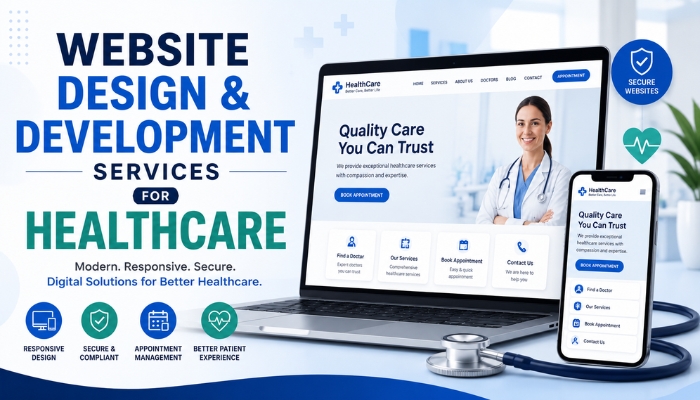
A professional website has become an important part of modern healthcare services. Patients increasingly use the internet to find hospitals, clinics, doctors, diagnostic centers, pharmacies, and other healthcare providers. A well-designed website gives healthcare organizations an opportunity to provide important information while making it easier for patients to connect with their services.
Website Design and Development Services for Healthcare focus on creating websites that combine professional design, simple navigation, mobile responsiveness, security, useful information, and convenient communication features. A healthcare website should not only look professional but should also help patients find the right information quickly.
From doctor profiles and medical services to appointment requests and contact information, every element should be organized around the needs of patients and healthcare professionals.
Why Healthcare Businesses Need a Professional Website
A healthcare website often serves as the first digital interaction between a patient and a healthcare organization. Before booking an appointment or visiting a clinic, patients may check the available services, doctor information, location, timings, facilities, and contact details online.
A professional Healthcare Website Development approach can help organizations present this information clearly while creating a trustworthy digital presence.
Key Benefits of a Healthcare Website
- Provides information about healthcare services
- Helps patients find doctors and specialists
- Supports appointment inquiries
- Improves online visibility
- Provides clinic and hospital information
- Supports patient communication
- Showcases facilities and services
- Helps build professional credibility
What Is Healthcare Website Design and Development?
Healthcare website design focuses on the visual appearance, usability, layout, navigation, and overall user experience of a medical website. Development involves converting the design into a functional website with features such as appointment forms, service pages, doctor profiles, contact systems, integrations, and content management.
A successful Healthcare Website Design should be simple enough for patients of different age groups and technical backgrounds to navigate comfortably.
Important Features of a Healthcare Website
1. Responsive Website Design
Patients may access healthcare websites from smartphones, tablets, laptops, or desktop computers. A responsive design automatically adjusts the website layout according to the visitor's screen size.
A mobile-friendly Medical Website Development approach makes important information such as doctor details, appointment forms, phone numbers, and clinic addresses easier to access from mobile devices.
2. Simple Website Navigation
Healthcare websites often contain large amounts of information. Patients should be able to locate services, doctors, departments, contact details, appointment options, and other important information without confusion.
Clear navigation menus and properly organized pages create a better user experience and help visitors find relevant information quickly.
3. Doctor and Specialist Profiles
Doctor profiles can provide patients with useful information before they decide to make an appointment. Profiles can include qualifications, specialization, experience, areas of expertise, consultation information, and other relevant professional details.
Well-organized doctor profile pages can make it easier for patients to identify the appropriate healthcare professional for their needs.
4. Healthcare Services Pages
Each major healthcare service should have clear and informative content. A dedicated service page can explain what the service involves, who it is suitable for, available facilities, and how patients can contact the organization.
For example, a hospital website may have separate pages for cardiology, orthopedics, dermatology, diagnostics, emergency services, and other departments.
5. Online Appointment Request
Appointment functionality can make it easier for patients to request consultations without making a phone call. An appointment form can collect basic information such as name, contact details, preferred doctor, preferred date, and appointment requirements.
For healthcare organizations handling a large number of appointments, the website can be connected with appropriate scheduling or management software.
6. Click-to-Call and WhatsApp Integration
Patients may have questions before booking an appointment. Providing convenient communication options can make it easier for them to contact the healthcare organization.
WhatsApp Integration and click-to-call functionality can help patients quickly connect with reception teams or customer support, depending on the organization's communication workflow.
Healthcare Website Features and Their Benefits
| Website Feature | Healthcare Benefit |
|---|---|
| Responsive Design | Easy access across smartphones and computers |
| Doctor Profiles | Helps patients choose suitable specialists |
| Service Pages | Explains healthcare services clearly |
| Appointment Forms | Makes appointment requests convenient |
| Contact Information | Helps patients reach the organization quickly |
| WhatsApp Integration | Supports convenient patient communication |
| Location and Maps | Helps patients find clinics and hospitals |
| FAQ Section | Answers common patient questions |
7. Secure Healthcare Website Development
Security is especially important for healthcare websites because organizations may handle sensitive patient-related information. A professional website should use appropriate security measures to protect forms, accounts, integrations, and website infrastructure.
HTTPS, secure authentication, access controls, software updates, backups, and secure hosting are some of the areas that should be considered during Healthcare Website Development.
8. Fast Loading Speed
Patients may leave a website if pages take too long to load. Healthcare websites should therefore be optimized for performance across both desktop and mobile devices.
Image optimization, efficient coding, suitable hosting, caching, and reduced unnecessary scripts can help improve website loading performance.
9. Search Engine Friendly Structure
Patients often search online for healthcare services, specialists, hospitals, and clinics in their area. A search-friendly website structure can help healthcare organizations improve their visibility in relevant search results.
A professional Healthcare Website Design strategy should include optimized page titles, headings, URLs, internal links, useful content, mobile responsiveness, and descriptive image information.
10. Easy-to-Use Contact Forms
A healthcare website should make it simple for patients to contact the organization. A clear contact form can collect basic information and help the healthcare team understand the patient's inquiry before responding.
Contact forms can be used for appointment requests, general inquiries, service information, feedback, and other communication requirements. Keeping forms short and easy to complete can improve the overall user experience.
11. Location and Google Maps Integration
Patients need accurate location information when visiting a hospital, clinic, diagnostic center, or healthcare facility. A dedicated contact page should include the complete address, phone number, operating hours, and an interactive map where appropriate.
Google Maps Integration can make it easier for visitors to find the healthcare facility and plan their route from their current location.
12. Frequently Asked Questions
A Frequently Asked Questions section can answer common patient queries without requiring them to contact the reception team for every basic question. FAQs can cover appointment procedures, consultation timings, available services, payment information, reports, facilities, and other general topics.
Well-written FAQs can also make healthcare websites easier to navigate and provide useful information before a patient decides to contact the organization.
13. Healthcare Blog and Educational Content
A healthcare blog can provide useful educational information related to services, treatments, wellness, medical procedures, and general healthcare topics. Regularly updated content can help healthcare organizations communicate with existing and potential patients.
High-quality content can also support Healthcare SEO by helping search engines understand the topics and services covered by the website.
14. Patient-Friendly User Experience
Healthcare websites should be designed around patient needs rather than simply focusing on visual appearance. Important information should be easy to read, buttons should be clearly visible, and navigation should remain straightforward.
A professional Medical Website Design should use clear typography, organized content, consistent layouts, and simple interactions so visitors can find information without unnecessary effort.
15. Website Accessibility
Healthcare websites should consider visitors with different abilities and accessibility requirements. Readable text, appropriate contrast, descriptive links, keyboard-friendly navigation, and properly labeled forms can create a more inclusive website experience.
Accessibility should be considered during the design and development stages rather than added after the website is completed.
16. Integration with Healthcare Management Software
Healthcare organizations may use different software systems for appointments, patient management, billing, staff management, communication, and other operational activities. Website integrations can help information move between systems more efficiently.
Depending on the organization's requirements, a healthcare website can be connected with appointment management systems, CRM platforms, communication tools, payment gateways, lead management software, and other relevant business applications.
17. Online Payment Integration
For healthcare organizations that accept online payments, a secure payment gateway can make transactions more convenient for patients. Depending on the service model, payments may be used for consultation bookings, diagnostic services, appointments, subscriptions, or other approved services.
Payment functionality should be implemented with appropriate security controls and should follow applicable payment and data protection requirements.
18. Healthcare Website Analytics
Website analytics can help healthcare organizations understand how visitors interact with their websites. Businesses can monitor important metrics such as traffic sources, popular pages, appointment form interactions, and other relevant actions.
These insights can help organizations identify which pages provide value and where improvements may be needed.
19. Lead Management Integration
Healthcare organizations can receive inquiries from website forms, advertisements, social media, search engines, and other channels. Managing these inquiries manually can become difficult as the number of leads increases.
Integrating Lead Management Software with a healthcare website can help businesses capture inquiries, assign leads to staff members, track follow-ups, and monitor lead status from a centralized system.
Lead Management Can Help Healthcare Businesses With:
- Website inquiry capture
- Lead assignment
- Follow-up tracking
- Lead status updates
- Staff notifications
- Source tracking
- Customer communication
- Lead reporting
20. WhatsApp API Integration for Healthcare Communication
WhatsApp can provide a convenient communication channel for healthcare organizations when used appropriately. With WhatsApp Business API, businesses can integrate WhatsApp communication with selected workflows and systems.
Depending on applicable policies and patient consent, businesses can use approved messaging for appointment-related communication, service updates, reminders, and customer support.
21. Website Security and Data Protection
Security should be a major consideration when developing a healthcare website. Organizations should carefully evaluate how forms, databases, user accounts, integrations, and other website components handle information.
Security practices can include HTTPS, strong authentication, access controls, regular software updates, secure backups, monitoring, and appropriate server configurations.
Healthcare organizations should also ensure that their website and associated systems follow applicable privacy, security, and data protection requirements for their region and type of service.
22. Regular Website Maintenance
Healthcare websites need ongoing maintenance after launch. Outdated software, broken forms, expired integrations, slow pages, or incorrect service information can negatively affect the user experience.
Important Maintenance Activities
- Security updates
- Regular backups
- Performance monitoring
- Broken link checking
- Content updates
- Form testing
- Integration testing
- Software and plugin updates
23. Benefits of Professional Healthcare Website Development
| Benefit | Impact |
|---|---|
| Better Online Presence | Helps healthcare organizations present their services professionally |
| Improved Patient Experience | Makes important information easier to access |
| Appointment Convenience | Allows patients to submit appointment requests online |
| Better Communication | Provides multiple ways for patients to contact the organization |
| Lead Management | Helps organize and track incoming inquiries |
| Search Visibility | Supports visibility for relevant healthcare searches |
| Mobile Accessibility | Allows patients to access information from smartphones |
| Scalability | Allows the website to support future business requirements |
How to Choose a Healthcare Website Development Company
Choosing the right development partner is important because healthcare websites often have specific requirements related to usability, communication, security, content, integrations, and scalability.
Before selecting a Healthcare Website Development Company, businesses should review the company's experience, development approach, technical capabilities, security practices, communication process, support services, and previous projects.
Things to Consider Before Hiring a Development Company
- Experience in healthcare website development
- Responsive design capabilities
- UI/UX design expertise
- Website security practices
- SEO-friendly development
- Third-party integration capabilities
- CMS and custom development options
- Post-launch maintenance and support
- Website performance optimization
- Scalable development approach
Conclusion
A professional healthcare website should do more than display basic information. It should provide patients with a simple, secure, responsive, and convenient way to learn about healthcare services and connect with the organization.
Website Design and Development Services for Healthcare can include responsive design, doctor profiles, service pages, appointment requests, contact forms, WhatsApp integration, location maps, healthcare content, analytics, lead management, and secure business integrations.
The right combination of features depends on the healthcare organization's services, target audience, operational requirements, and future goals. A well-planned Healthcare Website Development strategy can create a stronger digital presence while improving communication and making healthcare information easier for patients to access.
By focusing on usability, security, performance, accessibility, and relevant functionality, hospitals, clinics, diagnostic centers, and other healthcare businesses can create a website that supports both patient needs and long-term organizational growth.